

Demand surges for Texas Education Freedom Accounts with 123,000+ student applications filed
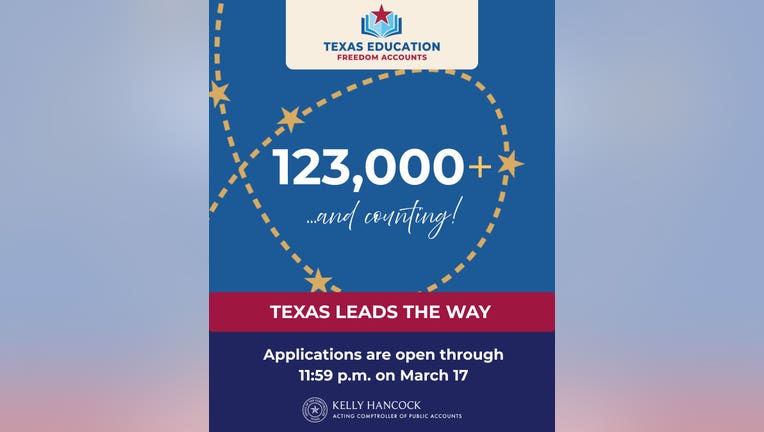
AUSTIN, Texas - The Texas Comptroller’s Office announced that more than 123,000 students applied in the first weeks of Texas’ new private school voucher program, far exceeding the number of spots available in its inaugural year.
$1 billion funding and 90,000 student limit
What we know:
The Texas Education Freedom Accounts program, which opened applications on Feb. 4, 2026, received 123,743 applications through Feb. 22.
The program is capped at $1 billion in its first year and will serve up to 90,000 students, as the deadline for applicants remains on Tuesday, March 17, 2026.
The figures suggest demand for the state’s new education savings account program is outpacing capacity just weeks after the application process went live.
High demand for Education Freedom Accounts
Dig deeper:
On the first day alone, more than 20,000 students applied, including nearly 8,000 within the first hour, according to Acting Comptroller Kelly Hancock.
The Texas Education Freedom Accounts program, established by Senate Bill 2, allows eligible families to use public funds to pay for approved education-related expenses, including private school tuition, textbooks, tutoring, transportation and certain therapies.

Texas reports 20,000 students applied for 'education freedom accounts' in first day
On the first day of open applications for the Texas private school voucher program, the state says 20,000 students threw their names in for consideration.
Funds are deposited into a state-managed education savings account, and parents direct payments to participating schools or approved vendors.
If applications exceed available slots, the law requires the state to prioritize families based on adjusted gross income.
Income Priority Tiers
By the numbers:
Eligible students can receive up to $10,474 annually to put toward private school costs. Students with disabilities participating in an Individualized Education Program may be eligible for significantly more. Funds that are not used in a school year will roll over if the student remains in the program.
The federal poverty level is used as a benchmark to determine eligibility for many public assistance programs.
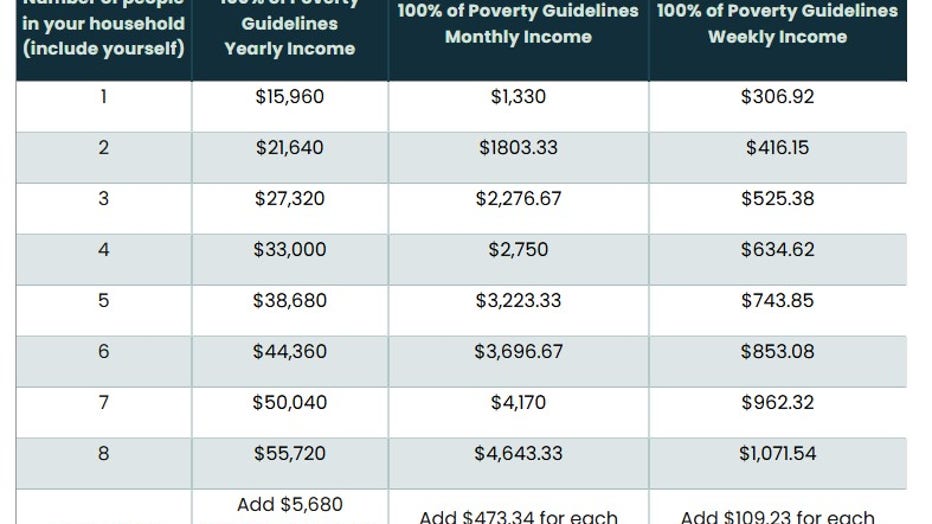
Via texaslawhelp.org
According to the application data provided by the Texas Comptroller:
- 35% of applicants come from households earning at or below 200% of the federal poverty level.
- 36% of the applicants fall between 200% and 500% of the federal poverty level.
- 29% of applicants report incomes above 500% of the federal poverty level.
- 11% of applicants qualify under a disability designation and earn 500% of the poverty level or less.
Public school vs. private school enrollment
The fact sheet also shows that 79% of applicants are currently enrolled in private school, while 21% are homeschooled or in other educational settings.
What they're saying:
Critics have raised concerns about the program’s income cap, which extends eligibility to families earning up to $165,000, arguing it may divert public dollars to families who can already afford private education.
State Sen. Royce West, a Dallas Democrat, has said that while he does not oppose private education, lawmakers must ensure the program is implemented fairly.
The lottery process
What's next:
With more than 123,000 applications filed in less than three weeks, state officials will begin reviewing submissions after the March 17 deadline, to determine which students receive one of the limited slots for the 2026-27 school year.
The Source: Information in this article was provided by the Texas Comptroller's Office.