

Texas death row inmate's case sent back to trial court by Court of Criminal Appeals
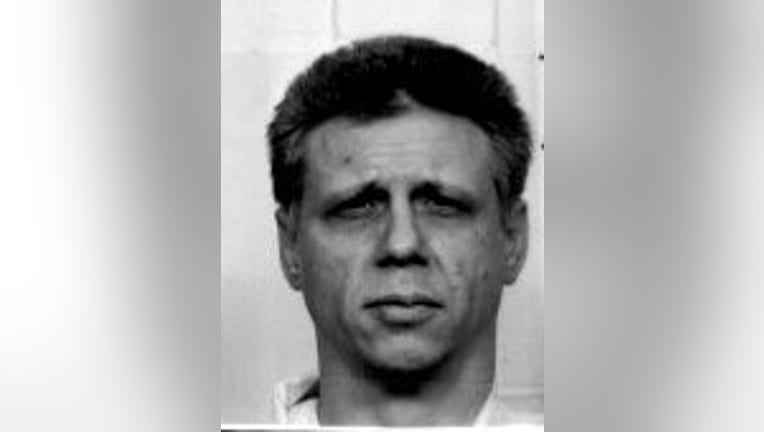
David Wood (Source: Texas Department of Criminal Justice)
AUSTIN, Texas - The Texas Court of Criminal Appeals has ordered a trial court to review a death row inmate's case after pausing the man's execution earlier this year.
The court's order sends the conviction of David Leonard Wood back to trial court for "development" of eight claims Wood's attorneys made concerning his innocence. Wood was convicted in 1992 of killing six girls and women in El Paso, Texas. Their bodies were found buried in the desert outside the city.
Nicknamed the "Desert Killer," Wood has been on death row longer than any other Texas inmate.
Claims made to the Texas Court of Appeals
The backstory:
Wood has always maintained he was innocent.
In Wood's filing he claimed the state obtained a conviction through false testimony and suppressing evidence.
Court documents claim the jailhouse informants that claimed Wood confessed to them were offered deals to falsify testimony in court.
Featured
As Texas readies 3rd execution of 2025, 'Desert Killer' asks for stay, DNA testing
Texas is getting ready to perform its third execution of 2025 on Thursday while the man set to be executed seeks to have that stopped.
Wood also claims his original counsel was ineffective and that his original attorneys were not afforded all the evidence available during discovery.
Wednesday's decision from the court did not specify which claims made by Wood should be developed in court.
The other side:
The lack of specificity in the order was pointed out by the dissenting judges.
Presiding Judge David Schenck said he agreed that the case should be sent back to the trial court, but questioned the lack of guidance in the majority opinion.
"The order provides no guidance for what exactly should be developed, timeline for development, requirement of proceedings, or any other direction supporting our ultimate decision to dismiss or determine the application on the merits," Schenck wrote.
Schenck said he believed the order should focus on DNA testing.
Still, Wood's attorneys celebrated the court's decision.
""We are grateful that the CCA recognized the seriousness of Mr. Wood’s claims, which present a substantial amount of new evidence showing Mr. Wood’s innocence, including evidence that was withheld by the State during his trial. We are grateful to have the opportunity to keep fighting to prove Mr. Wood's innocence," Jeremy Schepers and Greg Wiercioch said.
Other state and federal appeals
Wood appealed the court's decision unsuccessfully at both the state and federal levels.
He was originally scheduled to be executed in 2009.
Two days before his scheduled execution on Aug. 20, 2009, Wood filed a request claiming intellectual disability. The courts granted the request for a stay of execution, but Wood's claim was denied in 2014.
Since then, Wood has filed several motions requesting new items be DNA tested in order to prove his innocence.
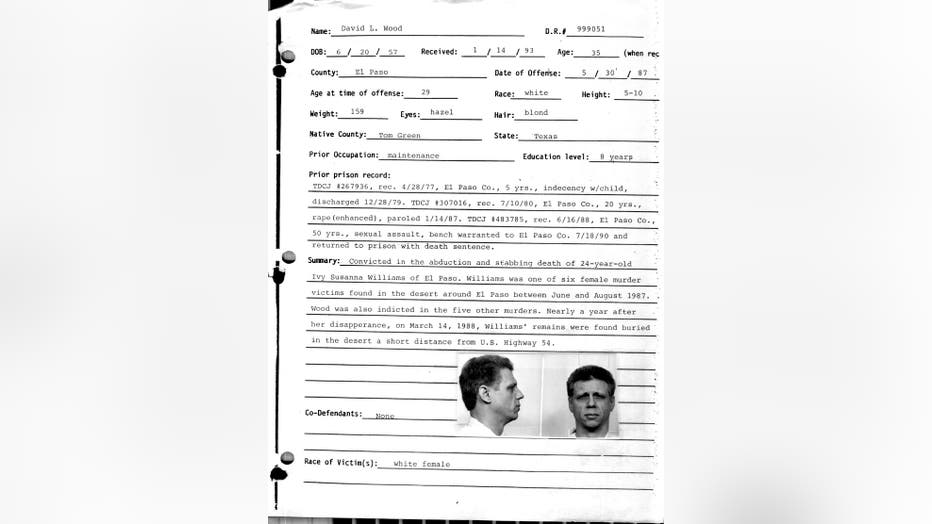
David Wood's prison file (Texas Dept. of Criminal Justice)
Texas law allows a person convicted of a crime to ask for forensic testing of evidence if certain requirements are met.
In 2010, the courts granted Wood's request to test three items using methods that were not available before. The court determined that the new evidence would not be enough to believe Wood would not have been convicted if it had been available.
Wood continued to file new requests for DNA testing until 2024 when the Court of Criminal Appeals said Wood's testing requests were being used to "unreasonably delay the execution of sentence."
The court ruled Wood was "purposefully attempting to delay the execution of his sentence."
1992 Trial - The Desert Killer
Six women disappeared from the El Paso area between May and August 1987. The bodies were found in shallow graves in a desert area near the city between September 1987 and March 1988.
During his 1992 trial, prosecutors laid out that five of the victims had been seen on the day of their disappearance leaving with a man on either a red Harley-Davidson motorcycle or a beige pickup truck, the vehicle descriptions matched vehicles owned by Wood.
Two of Wood's cellmates testified that he had confessed to each of them that he was responsible for the killings.
One of the cellmates testified that Wood described how he would lure the victims by offering them drugs before taking them to the desert.
Judith Kelling testified that Wood had offered her a ride home while she was walking in July 1987. She told the court that she accepted the ride, but instead of taking her home he took her to the desert where he tied her to his truck and started digging a grave behind a bush.
Kelling told the court that Wood said he heard voices and made her get back in the truck, and they drove to another location.
At the new location, Kelling said Wood sexually assaulted her and left her naked in the desert after again hearing voices.
A Dallas County court found Wood guilty, and he was sentenced to death.
The Source: Information in this article comes from opinions filed in the Texas Court of Criminal Appeals. Backstory on David Leonard Wood's previous court hearings comes from court records and previous FOX 4 reporting.