

Highly radioactive capsule found buried in West Texas

MIDLAND, Texas - A radioactive capsule was discovered buried outside Midland in West Texas last week.
What we know:
According to the Texas Department of Public Safety, a vehicle-mounted radiation detector on a trooper’s cruiser alarmed along South County Road 1210 on Friday. The trooper was able to determine that the source of the radiation was underground.
Officials said that teams from Midland, Texas DPS and Chevron security responded the next day and found the radiation source about 8 inches underground. It was identified as a capsule of Cesium-137 (Cs-137).
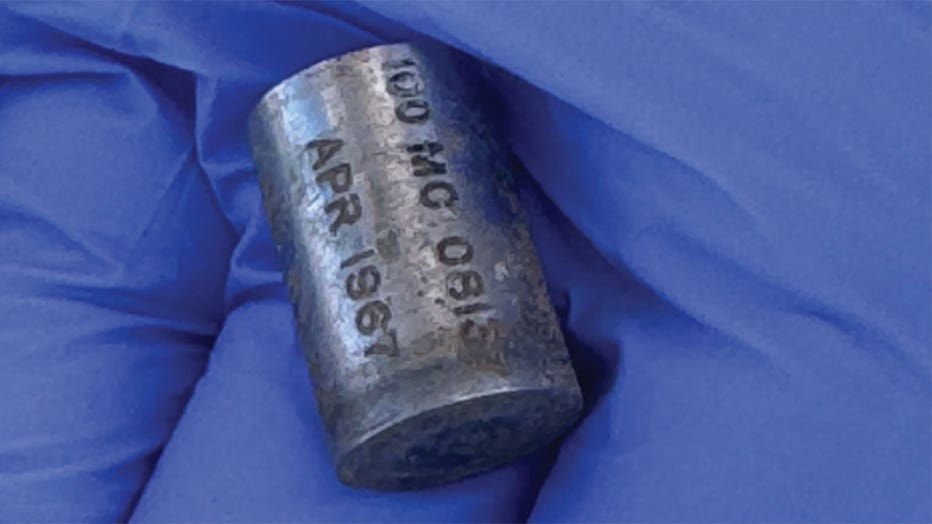
The Cesium-137 capsule that was found near Midland, Texas, on July 25, 2026. (Texas DPS / FOX Local)
What they're saying:
"The recovered item was identified as a 100-millicurie sealed radioactive source manufactured in April 1967," Texas DPS officials said in a statement released Wednesday. "After the source was documented and radiation readings were verified, it was safely recovered without incident. The operation concluded with no injuries, no personnel contamination and no threat to the public."
Featured

Energy Department says advanced nuclear reactor achieves first criticality milestone
Antares Nuclear’s microreactor at Idaho National Laboratory reached criticality, marking the first time a private company has achieved a self-sustaining nuclear chain reaction under a Trump administration pilot program.
Dig deeper:
Cs-137 is a highly radioactive human-made isotope that is a product of nuclear fission, according to the U.S. Environmental Protection Agency. It has several applications, including in gauges and medical devices.
While DPS said they could not provide information about how the capsule came to be buried, capsules of the isotope are often used by the oil industry to measure things such as the density of rock and soil as well as fluid flow, according to QSA Global, Inc., which makes capsules such as the one that was found. It was not clear to whom the capsule belonged.
Cs-137 has a half-life of about 30 years, meaning the capsule that was recovered was about half as radioactive as the day it was made. A sealed capsule prevents the isotope from interacting with the environment.
The Source: Information in this story came from the Texas Department of Public Safety, the U.S. Environmental Protection Agency and QSA Global, Inc.