

Texas can catch a lunar eclipse tonight
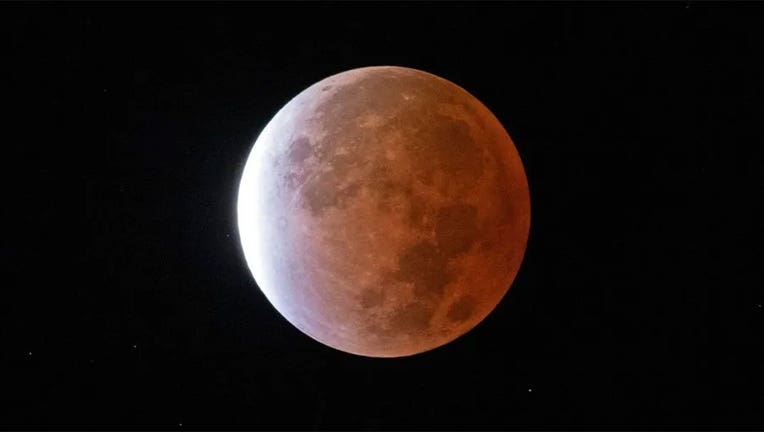
A nearly total eclipse of November’s full "Beaver Moon" captured over the city of New Orleans before dawn on Nov. 19, 2021. The 97% eclipse clocked in at 3 hours, 28 minutes, and 24 seconds, making it the longest partial lunar eclipse in 580 years. (NASA/Michoud Assembly Facility / FOX Local)
DALLAS - Texans will be treated to a spectacular astronomical show Thursday night.
What we know:
A partial lunar eclipse will be visible in Texas on Thursday night. According to NASA, about 93% of the Moon will take on a reddish color when it is covered by Earth’s shadow.
The partial eclipse begins at 9:33 p.m. CT, peaks at 11:12 p.m. CT and ends at 12:51 a.m. CT on Friday.
A lunar eclipse is safe to watch with your eyes. All you really need is clear weather.
PHOTOS: 'Blood moon' total lunar eclipse glows over North Texas
North Texas residents looked to the skies Tuesday morning to witness a total lunar eclipse, commonly known as a "blood moon," as the moon took on a deep reddish-orange hue.
What they're saying:
"Binoculars or a small telescope can give you a closer view of Earth's curved shadow moving across the Moon," NASA said.
Lunar eclipse meets full Surgeon Moon
Dig deeper:
The eclipse corresponds with August’s full Moon, called the Sturgeon Moon.
According to The Old Farmer’s Almanac, the name comes from Native Americans who found that sturgeon were readily caught in the Great Lakes region during this time of the year.
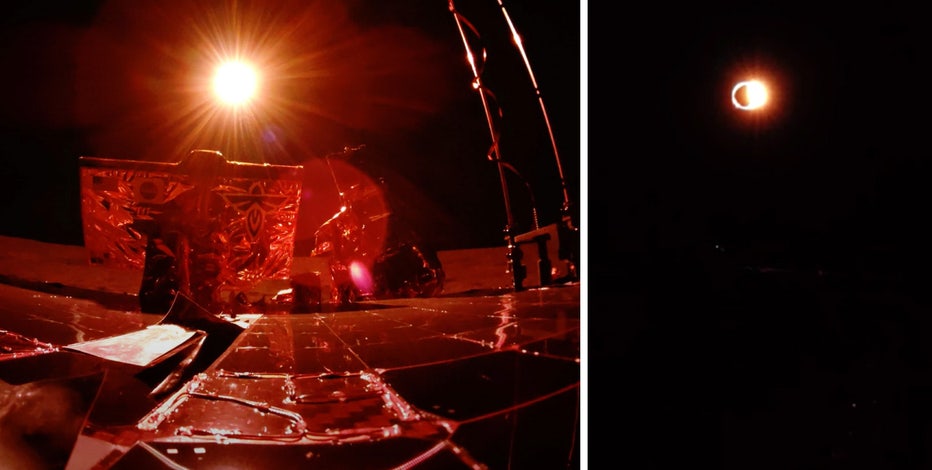
Photos: Lunar lander gets rare view of eclipse from the moon
While Earthlings were watching the moon turn blood red during Friday morning’s lunar eclipse, a robotic lander on the moon was looking back and getting a very different – and very rare – view.
What other stellar events are happening in August?
A solar eclipse happened Aug. 12, but it wasn't visibile in Texas. Totality moved across parts of Europe, but only a partial solar eclipse was visible in the northeastern U.S.
The Perseid Meteor Shower peaked on the evening of Aug. 12 through early Aug. 13. Look toward the northeast and the constellation Perseus to catch this show.
When’s the next one?
The next partial lunar eclipse visible from Texas is on Jan. 11-12, 2028. A partial solar eclipse follows on Jan. 26.
The Source: Information in this story came from NASA and TimeAndDate.