

Look up tonight: Quadrantid meteor shower will peak, joined by 1st supermoon of 2026
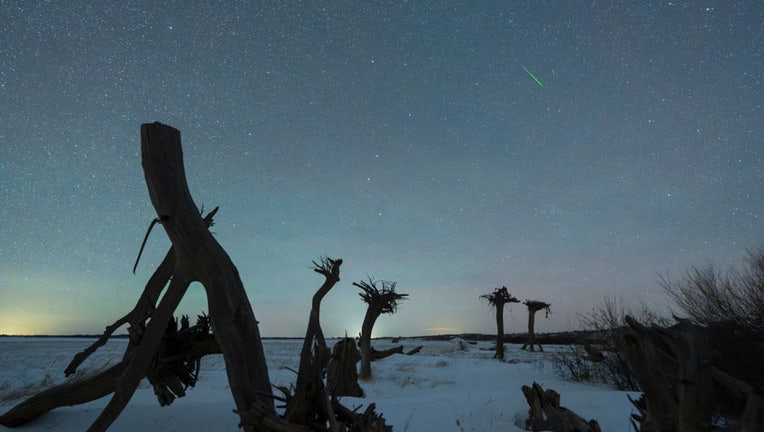
Quadrantid meteor shower is observed in the night sky on Jan. 3, 2025 in Duolun County, Xilingol League, Inner Mongolia Autonomous Region of China. (Photo by VCG/VCG via Getty Images)
Don’t forget to look up tonight!
Not only will the Quadrantid meteor shower experience its peak, the year’s first supermoon will shine bright, depending on weather conditions, of course.
Here’s what to know:
The Quadrantids meteor shower
Dig deeper:
The Quadrantids are unique for a few reasons, including timing and where the meteor shower originates.
Astronomers consider the meteor shower the best of the year because of the lack of moonlight.
This week’s supermoon and weather will make seeing the meteor shower challenging. Other annual meteor showers have one or two-day peak activity, but the Quadrantids' peak happens over a few hours with between 60 and 200 meteors per hour, according to NASA. The space agency said this short peak window is because the Earth crosses the asteroid particle stream at a perpendicular angle.
Most meteor showers come from leftover comets.
The Quadrantids are distinctive because they come from an asteroid known as 2003 EH1. NASA astronomers said it's possible 2003 EH1 is a "dead comet" or a "rock comet," but it's currently defined as an asteroid. The small asteroid is about 2 miles across and takes more than 5.5 years to orbit the Sun.
How to view the Quadrantids meteor shower
The meteor shower will peak on the night between Jan. 2 and Jan. 3, according to The Planetary Society.
Don’t yawn too much, or you might miss them.
The Quadrantids are best viewed away from light pollution after midnight and in the predawn hours. A warm drink, blankets and winter weather clothing are also a must for most in the U.S. during cold January nights.
The International Meteor Organization recommends facing north with the moon behind you to look for meteors.
Even with the cold conditions, it's a good time to step outside with a hot drink for some skygazing.
What's next:
The next active meteor showers don't happen until late April with the Lyrids and then in May with the Eta Aquariids.
January’s supermoon
Also on the celestial menu for this weekend is the first supermoon of the year, dubbed the Super Wolf Moon, which will be visible on Jan. 2 and Jan. 3, according to Earthsky.org.
The full moon reaches peak illumination at 5:03 a.m. ET on Jan. 3, according to Space.com.
The name stems from wolves howling during the first full moon of the year and it was believed the howled so much because they were hungry, according to the Almanac. This has been proven to be incorrect.
Wolves typically howl during the wintertime to locate pack members, define territory, coordinate hunting and create social bonds, the Almanac said.
Other traditional names for full moons in January include Center moon, Cold Moon, Frost Exploding Moon, Freeze Up Moon, and Severe Moon. It has also been called Canada Goose Moon, Great Moon, Greeting Moon and Spirit Moon.
The Source: Information for this article was taken from the Almanac, The Planetary Society, EarthSky.org, Time and Date and previous reporting by LiveNOW. This story was reported from San Jose.