

NASA Artemis II: Rocket arrives at Kennedy Space Center launch pad
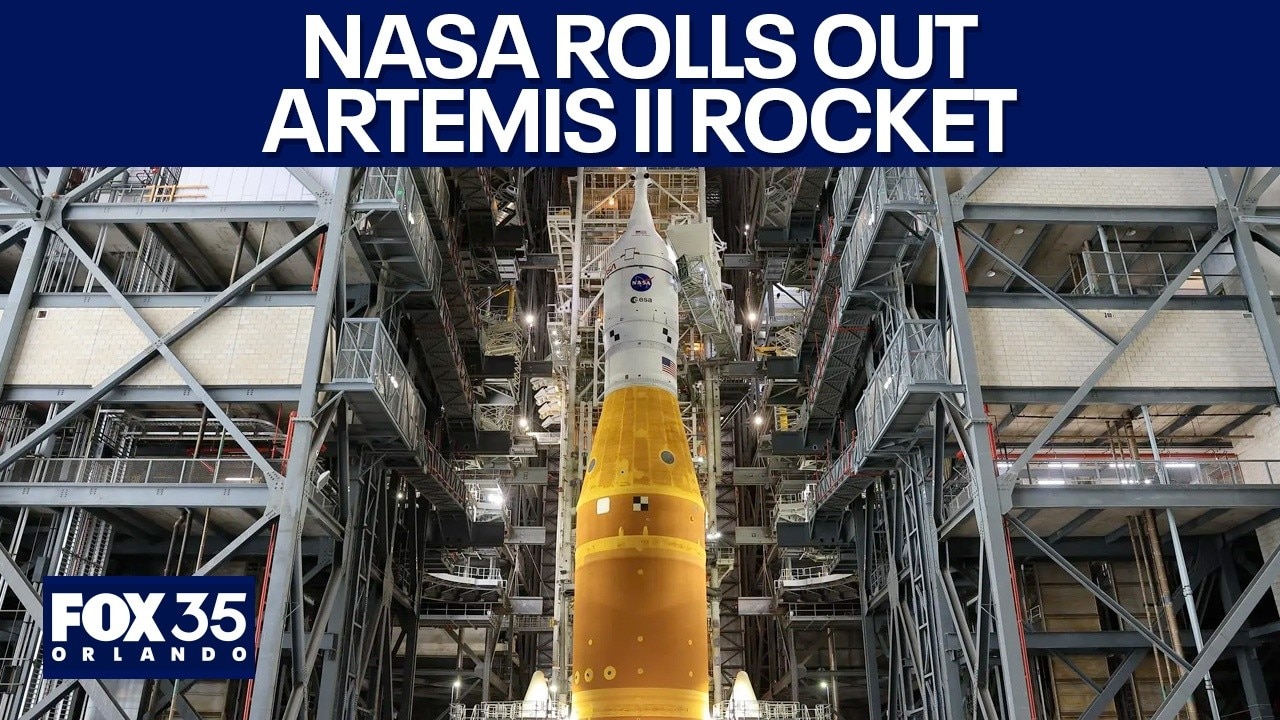
ORLANDO, Fla. - The Artemis II rocket and spacecraft completed the 4-mile trek to the launch pad at Kennedy Space Center on Friday morning, March 20, 2026.
The 11-million-pound stack docked at Launch Pad 39B at 11:21 a.m., according to NASA.
"We are gearing up for preparations ahead of launch of the crewed lunar mission," the NASA Artemis X account posted on Friday.
NASA is targeting April 1 as the earliest launch date for Artemis II, though there are a total of 7 launch opportunities in April.
Original story:
Artemis II has left NASA's Vehicle Assembly Building and is returning to the launch pad at Kennedy Space Center ahead of its next launch attempt in April.
NASA targeted Thursday night–around 8 p.m.–to begin the slow, 4-mile trek to Launch Complex 39B. After a delay, the rollout began after midnight.
Artemis II intends to send 4 astronauts on a 10-day mission to the moon's orbit, testing not only the capabilities of flying to deep space, but also to learn how deep space affects humans, before returning to Earth.
Watch live: Artemis II rollout
How long does it take to roll Artemis II?
It's a very slow stroll to the launch pad.
NASA's crawler-transporter 2 will transport the 11-million-pound rig to the launch pad overnight. The transporter moves at roughly 1 mph – and it's about a 4-mile journey to the launch pad.
The entire move can take up to 12 hours.
According to a NASA fact-sheet, the crawler-transporter 2 is roughly the size of a baseball infield. It weighs 6.6 million pounds and can transport up to 18 million pounds.
Here are the potential April launch dates for Artemis II
NASA has identified seven potential launch availability dates in April for the Artemis II mission. The first is April 1.
- April 1; 6:24 p.m.
- April 2; 7:22 p.m.
- April 3; 8 p.m.
- April 4; 8:35 p.m.
- April 5; 9:40 p.m.
- April 6; 10:36 p.m.
- April 30; 6:06 p.m.
Could NASA's Artemis 2 rollout get delayed again?
NASA engineers are targeting tonight at 8 to roll the Artemis II Space Launch System rocket and Orion spacecraft to Launch Pad 39B at the Kennedy Space Center. The Artemis crew entered quarantine last night to prepare for a launch next month. Ken Kremer, Managing Editor of Space UpClose joins FOX 35's Garrett Wymer live via Zoom to preview NASA's rollout and the odds of a successful string of events before the launch window opens next month.
NASA: Helium leak fixed
The backstory:
NASA teams rolled back Artemis II – a Space Launch System rocket and Orion spacecraft – back to the Vehicle Assembly Building (VAB) several weeks ago after an issue was found with helium flow in the rocket's upper stage.
There was an issue with a seal, which has since been fixed, NASA said during a recent press conference. Technicians also made adjustments to the rocket's flight batteries and charging system batteries on the Orion capsule.
Where is Artemis II headed?
The Artemis mission is a series of at least 5 space flights whose goal is to land astronauts on the moon.
- Artemis I (November 2020): An uncrewed flight to the lunar service and back to Earth, part of a 25-day mission.
- Artemis II (Tent. April 2026): A crewed flight to the moon's orbit and back to Earth, part of a 10-day mission.
- Artemis III (2027): Low-orbit demonstration flights of one or both commercial Landers from Space and Blue Origin. It will also be a crewed mission to test "rendezvous and docking capabilities between Orion and private commercial spacecraft needed to land astronauts on the Moon."
- Artemis IV (early 2028): This mission's goal is to land humans on the moon and have them transfer from the Orion spacecraft to a lunar lander. The goal is to figure out whether SpaceX's or Blue Origin's will house the astronauts. Work here will also be to standardize the SLS rocket.
- Artemis V (late 2028): A lunar surface mission, as well as the initial building of a "moon base."
NASA said it then envisions yearly launches.
Meet the astronauts
These are the four astronauts that will be part of the Artemis II mission:
- Commander Reid Wiseman
- Pilot Victor Glover
- Mission Specialist Christina Koch
- Mission Specialist Jeremy Hansen
The astronauts began their pre-flight quarantine on Wednesday, March 18, in Houston, Texas. They will remain in Houston until roughly a week before launch, where they will fly to Florida.
The Source: The information is from NASA, NASA press conferences, and NASA's Artemis web pages.