

Watch live: Solar eclipse dazzles across Europe, North America
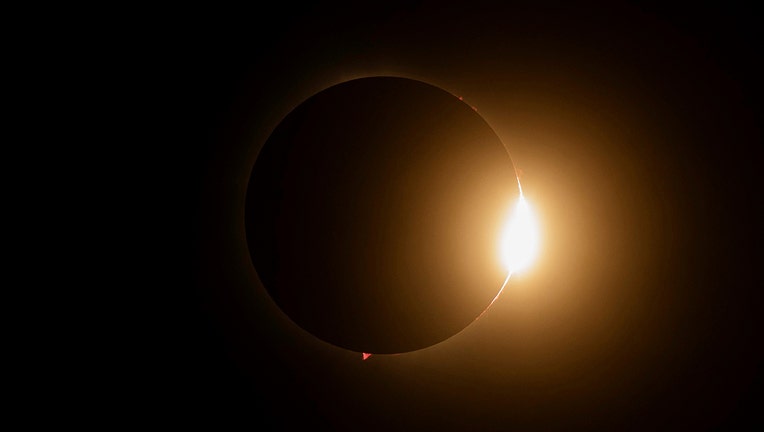
A total solar eclipse is seen from Port Stanley, Ontario, Canada, on April 8, 2024. The total solar eclipse swept across North America on April 8, 2024. (Photo by Zou Zheng/Xinhua via Getty Images)
Get ready sky watchers! A total solar eclipse will grace the heavens on August 12 and though it won’t be totally visible from the U.S., several northern states will get a chance to enjoy a partial solar eclipse.
Here’s what to know about the solar eclipse:
Where to watch from the US
Local perspective:
Parts of the Northern Hemisphere, from Alaska to North Carolina and most of Canada will have an opportunity to experience a partial solar eclipse.
People hoping to watch the eclipse from North America will be inside the moon’s shadow but outside the path of totality.
This means the moon will never completely block the sun and the eclipse will be partial only.
Watch solar eclipse live
How to see the eclipse safely
What you can do:
During a partial solar eclipse, it is never safe to look directly at the sun without proper eye protection.
Regular sunglasses are not safe, regardless of how dark they are.
NASA said safe eclipse glasses should comply with the ISO 12312-2 international safety standard and should not be used if they are torn, scratched or otherwise damaged.
RELATED: See it: Partial solar eclipse puts on a show across New England, Europe
Viewers should not look at the sun through a camera, telescope or binoculars while wearing eclipse glasses. Those devices concentrate sunlight and require specially designed solar filters attached to the front of the equipment.
People without eclipse glasses can use an indirect viewing method, such as a pinhole projector. The projector casts an image of the sun onto another surface, so viewers don't have to look directly at it.
RELATED: Photos: Lunar lander gets rare view of eclipse from the moon
For a list of approved eclipse-viewing eyewear, click here.
When is the 2027 solar eclipse?
What's next:
An exceptionally long total solar eclipse is in store for 2027, yielding nearly three times more observation time.
The southern tip of Spain will take center stage on Aug. 2, 2027, with up to six minutes and 23 seconds of totality extending into Morocco, Algeria, Libya, Egypt, Saudi Arabia, Yemen and Somalia.
The Source: Information for this article was taken from NASA and previous reporting by FOX Local. This story was reported from San Jose.