

Some Texas lawmakers stand against Trump executive order targeting state AI laws

POLAND - 2023/08/01: In this photo illustration, a Chat GPT logo displayed on a smartphone with Artificial Intelligence (AI) design in the background. (Photo Illustration by Omar Marques/SOPA Images/LightRocket via Getty Images)
Texas and the federal government may soon be at odds over a state law regulating artificial intelligence and an executive order from President Donald Trump that threatens to withhold federal funding to states that enact such laws.
The executive order signed earlier this month threatens to cut off federal broadband funding for states that pass "onerous AI laws."
Texas was awarded $3.3 billion in federal funding to expand broadband access in the state. A state law regulating AI in Texas is set to take effect on Jan. 1.
State Sen. Angela Paxton said Friday that AI regulation is necessary for the safety of children, consumers and infrastructure.
"I don’t think we should stop moving on our policies to protect our kids, consumers, privacy, and infrastructure the way we see fit in Texas before there is meaningful federal legislation," Paxton said on X. "We can’t be handcuffed by the federal government."
It's not the first time the McKinney Republican has spoken in favor of state regulation of AI. In November, she led a group of 16 state senators from both parties in a letter sent to U.S. Sens. Ted Cruz and John Cornyn asking them to support the Texas law and reject attempts by the federal government to restrict state regulation.
"If an AI moratorium is put in place, our important work on preventing child pornography, protecting data privacy, preventing discrimination, and holding Big Tech accountable in Texas will be rendered moot," the letter read. "Surely we can all agree that these kinds of state protections do not interfere with legitimate innovation and are reasonable and appropriate."
The other side:
Cruz has previously said that funding should be withheld from states that enact AI regulation. The senator called for the measure in July, saying state regulation would "strangle AI deployment."
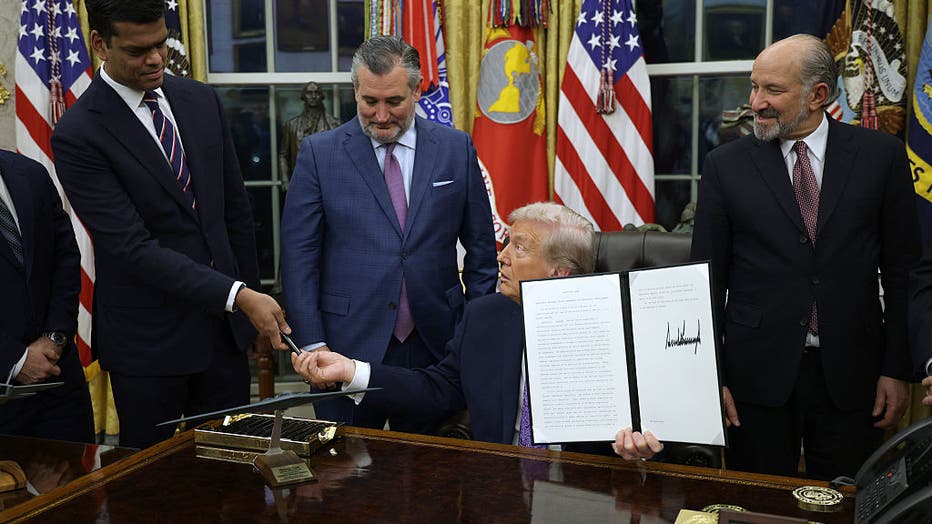
WASHINGTON, DC - DECEMBER 11: U.S. President Donald Trump hands a pen to Senior White House Policy Advisor on Artificial Intelligence Sriram Krishnan after signing an executive order while U.S. Sen. Ted Cruz (R-TX) (2nd L) and Commerce Secretary Howa
Cruz stood next to Trump as the executive order was signed, calling AI regulation a race to infuse the values of the country that wins into AI.
"We don’t want China’s values of surveillance and centralized control by the communist government governing AI," Cruz said in the Oval Office. "We want American values of free speech of individual liberty and respecting the individual."
Brendan Steinhouser, the CEO of The Alliance for Secure AI, applauded Texas' "considerable momentum in AI policy."
"Federal preemption would undo this good work, restricting lawmakers from making good policy decisions for Texans," Steinhouser said. "This would be a massive disservice to our children, families, and workers. Federalism is a core constitutional principle of this country. If we want to advance AI, the states need the freedom to legislate policies that protect their citizens."
In the letter, the state senators argue that state governments are able to act quicker in a crisis situation compared to the federal government.
"The states must not be handcuffed during a crisis, awaiting the federal government to do what states can and should do for themselves," the letter reads.
What does the executive order restrict
Dig deeper:
Trump's executive order seeks to ban state laws that conflict with federal policy and "check the most onerous and excessive laws" from states.
The order establishes an AI Litigation Task Force inside the U.S. attorney general's office to challenge state laws in court that they feel do not align with federal policy. State laws will also undergo an evaluation by the secretary of commerce to identify conflicts.
The executive order does allow an exception for state laws related to "child safety protections."
A federal block of state regulations also raised concern from the National Association of Attorneys General, who also sent a letter opposing the block.
"The attorneys general argue that broad federal preemption would undermine states’ ability to respond quickly and effectively to emerging AI risks," NAAG said. "They urge Congress to collaborate with states on thoughtful federal regulation, rather than imposing a blanket ban that could jeopardize public safety and innovation."
The letter was signed by 36 attorneys general. Texas Attorney General Ken Paxton was not among those who signed the letter.
Texas Responsible Artificial Intelligence Governance Act
House Bill 149 establishes a comprehensive framework for the governance, oversight and responsible use of artificial intelligence in Texas. It defines AI broadly, restricts the misuse of biometric data and requires government agencies to disclose when consumers interact with AI systems. The law prohibits AI designed to incite self-harm, crime, unlawful discrimination, social scoring by government or the creation/distribution of certain harmful or sexually exploitative content. The law also creates a statewide AI regulatory sandbox for controlled testing and the Texas Artificial Intelligence Council to advise on AI policy and ethical considerations.
FOX Local reached out to OpenAI and xAI for comment and have not heard back.
The Source: Information in this article comes from an executive order signed by President Donald Trump on Dec. 11, 2025, and a letter sent by Texas state senators to U.S. Sens. Ted Cruz and John Cornyn in November.