

Canada not a US subsidiary, Carney says; Trump posts ‘fall in line’
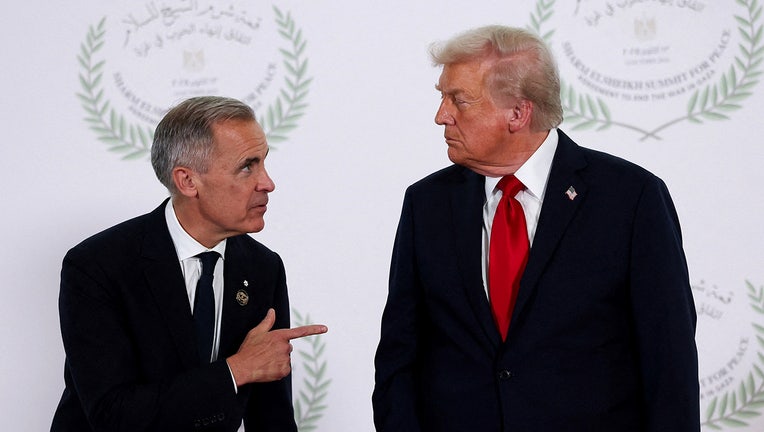
U.S. President Donald Trump and Canadian Prime Minister Mark Carney speak as they pose for a photo, at a world leaders' summit on ending the Gaza war on October 13, 2025 in Sharm El-Sheikh, Egypt. (Photo by Suzanne Plunkett - Pool / Getty Images)
The trade war between the United States and Canada became a war of words on Monday. Prime Minister Mark Carney accused Washington of trying to subordinate his nation, while President Donald Trump threatened worse consequences if Canada does not "fall in line."
What they're saying:
Carney signaled his nation was ready to find a solution to the dueling tariffs, but only if the U.S. approached the talks as happening between two sovereign nations, saying, "An attitude at the negotiation table that Canada is a subsidiary of the United States [is] not something we are going to accept."
"Without the United States, Canada couldn’t survive — It’s where they get all of their money and, because of their current bad leadership, primarily Governor Carney, and his Flunky, Ford, they will not be allowed to keep taking advantage of the United States," Trump wrote in a post that also referenced Ontario Premier Doug Ford, who had talked about the tariffs during a Monday afternoon news conference.
RELATED: Trump's plan to lower beef prices faces pushback from ranchers and some Republicans
What's next:
Trump warned that the U.S. could implement 50% tariffs on Canadian vehicles, auto parts, and steel, which led Carney to accuse Washington of trying to dismantle its automobile industry. The president went on to blast Canada’s "ridiculously high tariffs" on American farmers.
Ford, whose political party normally opposes Carney’s, said that "everything is on the table" if the trade war persists, including cutting electricity and critical minerals from his home province. He also insisted that Canadians are "in for an economic war. They know they’re going to have to sacrifice."
The backstory:
Over the weekend, the U.S. imposed 50% tariffs on approximately $28 billion worth of Canadian goods after Carney ended last-minute trade negotiations, citing changes by the American side.
The Office of the U.S. Trade Representative, on the other hand, stated that Canada refused to finalize terms that were agreed to earlier in the week. Prior to the tariffs going into effect last week, the two countries had extended talks for three days, leading Trump to say that a deal had been reached.
Carney later announced retaliatory tariffs against the U.S. that would match dollar-for-dollar the ones implemented by Washington. He said they would go into effect on September 8.
The Source: Information for this article was taken from The Associated Press. This story was reported from Orlando.