

Hearing on birthright citizenship: Supreme Court arguments explained

Birthright citizenship argued before Supreme Court
President Trump's agenda against birthright citizenship is in the hands of the Supreme Court tonight as the justices debate whether federal judges can issue sweeping injunctions to block his executive order.
DALLAS - The United States Supreme Court heard arguments on Thursday over President Donald Trump’s controversial executive order ending birthright citizenship.
SCOTUS hears birthright citizenship arguments
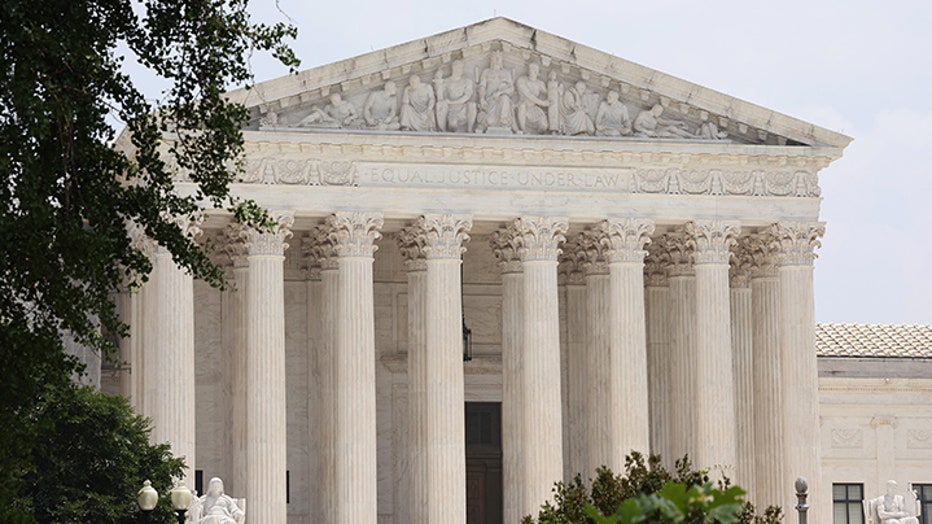
The U.S. Supreme Court is pictured on June 30, 2023 in Washington, DC. (Credit: Kevin Dietsch/Getty Images)
What we know:
Trump’s ambitious agenda is in the hands of the Supreme Court as the justices debate whether federal judges can issue sweeping injunctions to block the president’s executive orders, including the ban on birthright citizenship.
The order denies citizenship to children born in the U.S. to parents who are in the country illegally.
Three federal judges have issued injunctions blocking the directive, arguing it violates the 14th Amendment.
But the justices are not yet ruling on its constitutionality. They are ruling on whether the president can implement his policy while it’s being challenged in court.
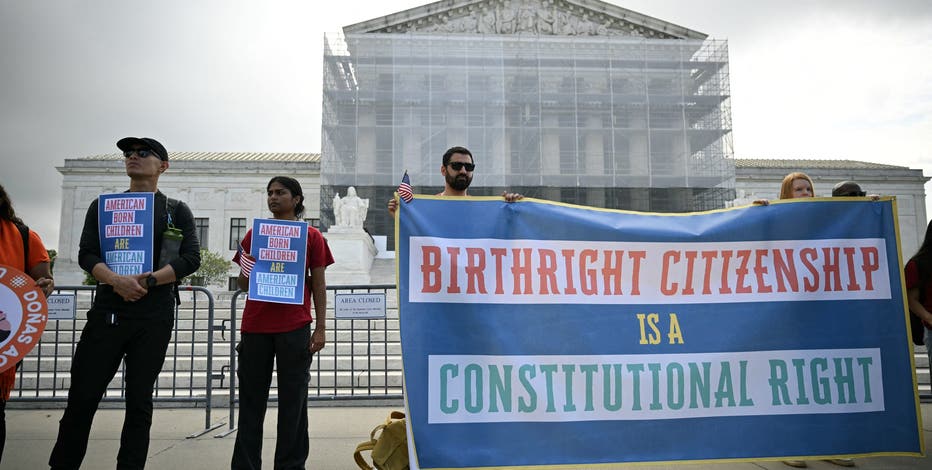
Supreme Court hears arguments over birthright citizenship: What to know
The Supreme Court is hearing arguments over whether to allow the Trump administration to block birthright citizenship in at least 27 states until it makes a final ruling.
Constitutional lawyer explains the case
What they're saying:
Constitutional lawyer David Coale sat down for an interview with FOX 4’s Steven Dial. He said the concept of birthright citizenship has been part of the 14th Amendment, and the Supreme Court has agreed with it since the late 19th century.
"So if they were going to make some inroads on that or have some different views, that would be a significant change to a very long-standing precedent," he said.
We got to this nationwide injunction topic because of a bigger topic – birthright citizenship. How are the two connected?
"Some policies are by their nature nationwide. And when you're talking about the executive order dealing with birthright citizenship, you're taking about the United States Constitution. Only got one. It's a provision of the 14th Amendment. And you're talking about an executive order. There's only one chief executive. That's the president. And so any court order that's going to deal with that effectively necessarily has to be national in scope to really mean anything because that's the stakes of what you're talking about," Coale said.

Explainer: Supreme Court reviews birthright citizenship
Constitutional lawyer David Coale explains what the Supreme Court will review on Thursday when it takes up the issue of birthright citizenship. There are really two questions that need to be answered.
When we are talking about birthright citizenship and, you know, being in Texas, it kind of means a little bit more to some people because we have such a large population that fits that category. I've talked to you multiple times about this. But tell me why, from your professional and legal perspective, the 14th Amendment protects this right.
"A case called Dred Scott that held that children of slaves and people brought into this country in slavery were not citizens of the United States. The 14th and then the birthright citizenship clause was intended to overrule that case, get everybody on equal footing. We're all citizens now, and then go forward from there. So, because that's the original understanding of the amendment, it's a little difficult to now argue that, well, but there are these other people that came from somewhere that aren't covered by that. I mean, the amendment was designed to cover people that had been brought into the country against their will and to make them be citizens. With that as the background, it is hard to do a lot of carve-outs from that to make a whole lot of sense," Coale said.
So, the oral arguments happened. Are we thinking a month, months to find out how the justices rule?
"I think the country wants to know. I think that this is a test, not only of this particular policy, but of, you know, what are we gonna do about all these executive orders? How are we going to handle court challenges to them? There's a bunch of lawsuits all across the land that are wanting an answer to that question. So, I think here at the end of the term and wanting to get it done sooner are going to kind of come together. And in a month or so, I think we can realistically expect to get an opinion. I'd be surprised if they let it sit through the summer," the lawyer said.
The Source: FOX 4 reporter Steven Dial talked to constitutional law attorney David Coale to gather information for this story.