

GOP revives battle over whether undocumented children can attend public schools
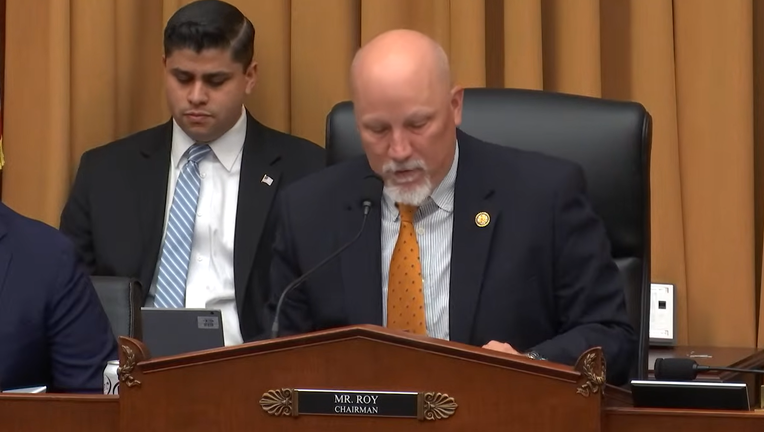
Rep. Chip Roy (R-Texas) delivers comments during the March 18 House Judiciary Subcommittee on the Constitution and Limited Government meeting.
WASHINGTON - U.S. House Republicans are taking aim at a 40-year-old Supreme Court ruling that guarantees children have a right to a public education regardless of their immigration status.
The House Judiciary Subcommittee on the Constitution and Limited Government held a hearing Wednesday on the impact of the 1982 Supreme Court decision, Plyler v. Doe. The decision requires states to provide a K-12 education to all children regardless of immigration status. During Wednesday's meeting, titled "The adverse effects of Plyler v. Doe," U.S. Rep. Chip Roy, of Texas, argued that immigration and education are not fundamental rights granted by the constitution, and not subject to protection under the 14th Amendment's Equal Protection Clause.
U.S. Reps. Brandon Gill and Wesley Hunt, also of Texas, are members of the same committee.
What they're saying:
"It's time we meet the moment to overturn Plyler v. Doe," the Roy said in his opening statement. "It's time for Congress and the courts to address the glaring failures of this court decision and finally alleviate Texans and Americans alike from this burden."
Roy's argument is that as immigration increases, both legal and illegal, the burden falls on taxpayers and state governments should be allowed to change the rules.
"Any amount of illegal immigration in our hospitals, jails, schools or elsewhere should not be tolerated and definitely represents a significant burden on taxpayers," Roy said. "States should have the ability to curb it."
Molly Drogin, a senior fellow for the Texas Public Policy Foundation, testified in front of the committee that the financial impact of the Plyler decision on taxpayers and school districts was hard to determine since districts are not allowed to ask students about immigration status.
"This contradiction undermines the logic of Plyler itself," Drogin said. "If undocumented children face serious disadvantages – as the Court recognized – schools must be able to identify these students in order to provide appropriate support. Right now, schools are required to meet complex educational needs affecting students, schools and entire districts while operating in the dark."
Drogin's testimony centered on a 2011 letter from the Department of Justice and Department of Education that said schools should not ask for the immigration status of its students and failure to allow all children to enroll in public schools could open the districts up to civil rights investigations and the loss of federal funding.
The other side:
Texas state Democrats said even the suggestion of reopening the case raises the uncertainty surrounding families as the Trump administration makes sweeping changes to the immigration system in America.
"Simply holding a hearing to question whether children should have access to public education sends a damaging signal to schools, educators, and families," state Reps. Ramon Romero and Gene Wu wrote in a letter to the committee. "Public education is foundational to economic opportunity and a strong workforce. Reopening settled constitutional questions does nothing to strengthen our education."
Texas legislature sought to restrict access to public education for undocumented children
During the last Texas legislative session, Republican lawmakers sought to end access to public education for non-citizen children when Flower Mound state Rep. Ben Bumgardner introduced HB 371.
The bill would have allowed only citizens and those legally in the U.S. to be automatically enrolled in public schools in Texas. Children in the state illegally would only be allowed in public schools if funding for the child came from the federal government.
The bill was sent to the education committee and was never heard.

DOJ ends Texas in-state tuition for the undocumented
PREVIOUS COVERAGE: A legal settlement between the U.S. Department of Justice and Texas will end in-state college tuition for undocumented students, a program that has been in place for nearly 25 years.
Texas DREAM Act ended
Lawmakers were successful in overturning a 2001 law that provided in-state tuition rates for undocumented students.
The law allowed students without legal resident status to qualify for in-state tuition if they have lived in the state for three years before graduating from high school, and for a year before enrolling in college. They must also sign an affidavit promising to apply for legal resident status as soon as possible.
The Texas Dream Act was signed into law by Republican Gov. Rick Perry with bipartisan support in the state legislature.
Last year, the Justice Department sued Texas, claiming the Dream Act violated federal laws.
A settlement between the sides was announced later that same day.
The program serves around 20,000 students in Texas, according to the nonprofit organization Every Texan.
Lawmakers had filed legislation to repeal the law before the DOJ agreement. Senate Bill 1798 passed out of committee during the last session, but was marked as "not placed again on intent calendar." House Republicans filed multiple bills seeking to overturn the law.
Public education is protected under the Equal Protection Clause of the Fourteenth Amendment
The backstory:
In 1975, Texas changed its education laws to block enrollment and deny state funds for the education of undocumented students.
After a lawsuit was filed on behalf of students who were unable to establish their immigration status, a federal district court found that undocumented immigrants were entitled to protection under the Fourteenth Amendment's Equal Protection Clause. The court ruled that the Texas law would not fill "either the purpose or effect of keeping illegal aliens out of the State of Texas" and that increased enrollment in the state's public schools was mostly from children who were legal residents.
The case was appealed all the way to the U.S. Supreme Court in 1982 where the court upheld the district court ruling in a 5-4 decision. The court said "education has a fundamental role in maintaining the fabric of our society" and "provides the basic tools by which individuals might lead economically productive lives to the benefit of us all." The court said there was no evidence that the exclusion of undocumented children from the Texas public school system would improve the education provided.
The Source: Information in this article came from testimony heard during the March 18 House Judiciary Subcommittee on the Constitution and Limited Government. Comments from Texas Democrats came from a letter sent to the committee. Backstory on Texas legislative attempts to block access to public education came from bills filed during the 2025 legislative session. Backstory on the overturning of the Texas DREAM Act came from previous FOX Local reporting.