

COVID-19 long haulers continuing to suffer long-term coronavirus symptoms

COVID-19 long haulers continuing to suffer long-term coronavirus symptoms
It’s still too early to understand all of the long-term effects of COVID-19, but right now, some groups of long-haulers are reporting debilitating symptoms months after their diagnosis.
It’s still too early to understand all of the long-term effects of COVID-19, but right now, some groups of long-haulers are reporting debilitating symptoms months after their diagnosis.
“It’s just been a horrible ride,” 27-year-old Miranda Erlenson said.
Erlenson, a wife and mother of three, said there’s only one second when she wakes up each day when she feels normal.
“For a second you forgot. You forgot you were sick. You forgot about anything because it was just alarm, wake up, but in that second when you lean over to get out of bed, it hits you so hard,” she explained.
Erlenson is a COVID-19 long-hauler, which is someone who is still sick even after fighting off the virus.
A recent CDC survey suggested about a third of unhospitalized coronavirus patients don’t fully recover after the standard two to three weeks.
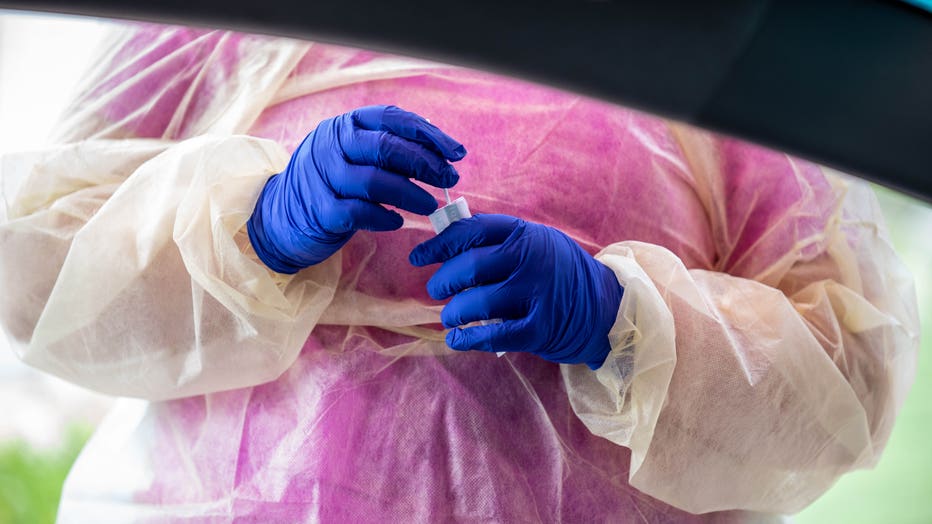
A nurse prepares to swab a patient at a COVID19 testing center on July 7, 2020 in Austin, Texas. (Photo by Sergio Flores/Getty Images)
Erlenson said she got sick in March, but is still feeling the virus’ effects in December.
“You’re waking up at 10%, and every night, you know, you’re back to 0% and you’re hoping that getting rest you’ll wake up better,” she said.
Erlenson said she’s developed chronic symptoms, including a heart condition called POTS. It stands for Postural Orthostatic Tachycardia Syndrome. Symptoms include an increased heart rate with low blood pressure upon standing.
“I cannot move myself to my toilet from my wheelchair,” she said. “My heart was beating 195 beats per minute.”
“When they stand up, gravity sucks blood below the heart. The heart becomes very, very empty and that leads to a reflex response which is a very high rate, rate in the upright position,” explained Dr. Benjamin Levine, who is a cardiologist.
Levine is a UT Southwestern professor of cardiology, and runs a research institute for Texas Health Presbyterian Hospital.
He said long-hauler clinics are evaluating patients who continue to feel ill after initially fighting off the virus. He’s researched POTS for years, and it’s commonly triggered by a virus.
But he added that while some COVID-19 patients display the symptoms, at this time, he can’t say for sure what it is.
“I think that there clearly a number of patients who do feel a variety of symptoms of lightheadedness and dizziness, some of them with a low blood pressure, some of them with a high heart rate, some of them without either, but we just don’t have enough information, yet,” he explained.
“Instantly, I get dizzy, my blood pressure changes too quickly,” Erlenson added.
Erlenson is a teacher, but she hasn’t been able to teach since getting sick. She spends her time running a Facebook page, “COVID survivors from Texas.” It’s where she said other long-haulers, like her, are searching for answers.
“It’s not from fear, it’s because we know. It’s from the knowledge of what it can do to you and how we have never been the same,” she explained.
Dr. Levine says prolonged bed rest can produce these cardiac symptoms seen in POTS patients, and often times, these COVID-19 long haulers are so fatigued they’re spending months in bed.
Still, he said he has a monthslong conditioning program that’s shown successful results with getting patients back to normal.