

After the penny, Congress looks to tackle the cost of the nickel
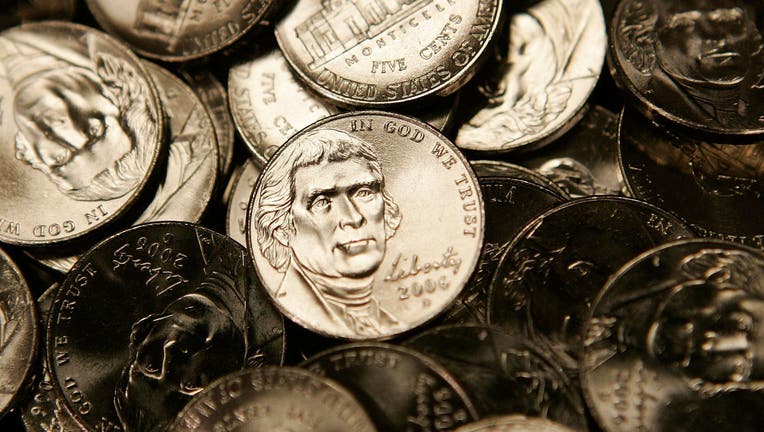
New U.S. nickels are shown on display at an unveiling ceremony January 12, 2006 in Washington, DC. The new nickel, last of the Westward Journey Nickel Series, is the first U.S. coin featuring the image of a president facing forward instead of in prof
After Congress moved to eliminate the penny, some lawmakers say the nickel should be next in efforts to make U.S. coins more cost-efficient to produce.
The backstory:
Last month, U.S. senators passed a bipartisan Common Cents Act to formally end the production of the copper coin, sending the bill to President Donald Trump’s desk for his signature.
However, another portion of the bill allows the Treasury department to study the potential of using cheaper materials to make the nickel. The five cent coin currently costs taxpayers eight cents more per coin.
What they're saying:
"If it costs 13 cents to make a five-cent coin, Washington should fix the problem instead of wasting more taxpayer money," House GOP Conference Chair Lisa McClain, R-Mich., told Fox News Digital. "My bill gives Treasury a path to make nickels at a lower cost without disrupting how Americans use them. It is a simple reform that saves money and brings a little more common sense to government."
What we know:
If testing shows that production costs can be reduced without significantly disrupting coin-operated machines, then the Common Cents Act authorizes a lower-cost nickel composition, according to a news release from McClain.
What we don't know:
Support for ending nickel production altogether still remains unclear at this point.
RELATED: Bill to end minting pennies passes Senate, heads to Trump’s desk
Current pennies are still good
Nothing changes for the pennies that are already in circulation, and there are a lot of them. The Mint reported that it produced 3.2 billion pennies in 2024 alone.
Dig deeper:
The bill, dubbed the Common Cents Act, includes procedures for stores to use as pennies are phased out and allows them to round transactions to the nearest five cents.
Some states are already bracing for a post-penny world. For example, New Jersey introduced a rounding law in June that stores could use. The rules apply only to cash transactions, while digital payments, wire transfers, and other non-cash transactions would still be charged down to the exact cent.
The legislation created a precise formula for how shops would round off totals. Per the bill, totals that end in one, two, six or seven would be rounded down. Totals that end in three, four, eight or nine would be rounded up.
The Source: This story was written with information provided by Fox News Digital and previous reporting by LiveNOW from FOX. This story was reported from Orlando.