

Texas redistricting: TX Supreme Court rejects removal of state Democratic lawmakers
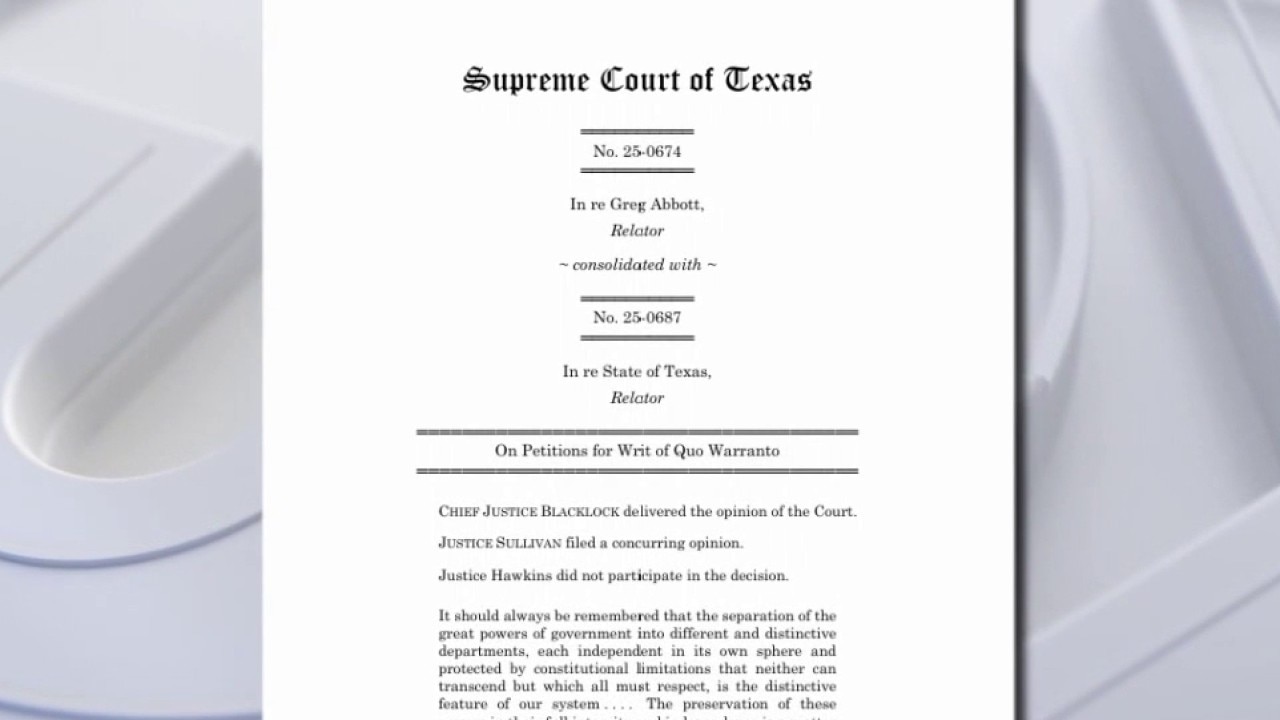
Texas Supreme Court ruling on Dem quorum breakers
The Texas Supreme Court has rejected Gov. Abbott's call for Democrats who broke quorum during redistricting to be removed from office. FOX 7 Austin's Jenna King reports.
AUSTIN, Texas - The Texas Supreme Court has rejected the removal of state Democratic lawmakers who broke quorum over redistricting.
What they're saying:
The court refused to declare that the lawmakers who broke quorum and fled the state in 2025 to block a vote on new congressional maps had vacated their offices.
In denying the request from Governor Greg Abbott, the court opinion written by Justice James Blacklock said that the Republican-majority Legislature had adequately resolved the problem itself through measures such as fines against the missing lawmakers, and it noted they eventually returned on their own within a few weeks.
"In the end, a quorum was restored in two weeks’ time, without judicial intervention, by the interplay of political and practical forces," Blacklock wrote.
"Courts have uniformly recognized that it is not their role to resolve disputes between the other two branches that those branches can resolve for themselves," the opinion said.

Texas redistricting: Dems leave state, break quorum
Gov. Greg Abbott issues an ultimatum as Texas Democrats leave the state to break quorum in the latest development in the state's redistricting fight.
Reaction to ruling
Andrew Mahaleris, press secretary for Gov. Greg Abbott, issued a statement on the ruling, saying:
"No elected official has the right to abandon their duties, flee the state, and shut down the people’s business. Governor Abbott’s legal action is what brought derelict Democrats back to Texas to do their jobs and pass the Big Beautiful Map. Now, SCOTX has warned them against pulling a similar stunt in the future. If Democrats abandon their offices again, the Governor will bring them right back to the Texas Supreme Court."
State Rep. Gene Wu, who also serves as the Texas House Minority Leader, said:
"When Greg Abbott threatened to arrest and expel us for denying him a quorum, we told him he should ‘come and take it.’ He tried!
"Abbott sent us threats. He sent lawyers. He sicced his lapdog, Ken Paxton, on us. He asked the highest court in Texas to remove elected Democrats from office because we refused to be bullied into helping him pass a rigged map for Donald Trump. Today, the Republican-controlled Supreme Court said: no. The Constitution does not let a Governor erase voters’ choices when their choices are inconvenient to him.
"Abbott was wrong, weak, and after all his bluster he couldn’t come and take a damn thing."

Texas House still doesn't have a quorum
The quorum break by Texas House Democrats continues at the Texas Capitol and new details are coming out about the effort to break up the walkout, which includes the creation of a tip line to report the whereabouts of the missing lawmakers.
The backstory:
In August 2025, Gov. Abbott filed a lawsuit to remove Rep. Wu, the Texas Democrat Caucus Chair, from office.
Abbott filed the emergency petition to the Texas Supreme Court of Texas for Wu's removal, citing his promise to attempt to do so for Democrats who left the state to prevent redistricting efforts.
The lawsuit claimed that Wu's actions as the state House's party leader, along with other Democrats who broke quorum, were an abandonment of their office. According to the governor, this justified their permanent removal from their positions.
Abbott also mentioned the Democrats' alleged acceptance of money from constituents and donors to skip the vote, saying accepting bribery for abandonment of office was grounds for vacating their seats.
Political expert weighs in
Dig deeper:
"He was hoping the courts would remove Wu under the guise that he had abandoned his office, which is something in the Texas Constitution. The Court, however, said that was not the case," said Brian Smith, political science professor at St. Edward's University.
"In a republic, the governor can't unilaterally remove elected officials. This is why we have elections. And if you are going to remove officials, it's usually done through that legislative body, meaning the state legislature can't expel members of their own body with the super majority," said Smith.
"The courts weren't willing to jump in, really for the first time and say, okay, quorum breaker, you've abandoned your office, you're done. They just weren't willing to do it. They looked and they said, this is an area we don't want to get involved in," said Smith.
"The courts kind of hinted saying you know what, if it happens again, we'll be ready for it and we might give it the diligence that it deserves," said Smith.
Texas' redistricting's wider impact
Big picture view:
The redistricting efforts in Texas began an effort by both parties across the country to redraw voting and congressional maps ahead of the November midterm elections.
In December 2025, the Supreme Court of the United States decided to allow Texas to use its newly redrawn congressional map for the 2026 election.
California and other states subsequently began redrawing their own maps.
Recently, the U.S. Supreme Court limited the scope of a key Voting Rights Act provision that restricts how states draw districts affecting minority voters, constraining states' use of race as a factor when drawing congressional maps ahead of the 2026 midterms.
This recent decision sparked more states to begin redrawing districts.
The Source: Information from Associated Press, interviews and reporting by FOX 7 Austin's Jenna King and previous reporting.