

The recycled space shuttle parts that will power Artemis II towards the moon

America gets excited about space again
The space shuttle was an icon of the 1980s, promising a new era of space travel. In this LiveNOW & Then full episode, we look at media coverage of its successes and its competition behind the Iron Curtain.
CAPE CANAVERAL, Fla. - NASA’s Artemis II mission is scheduled to launch this week, carrying four astronauts on America's first trip around the moon in over 50 years. As the SLS rocket thunders into space, it will be powered by engines that have been recycled from the retired space shuttle fleet.
The backstory:
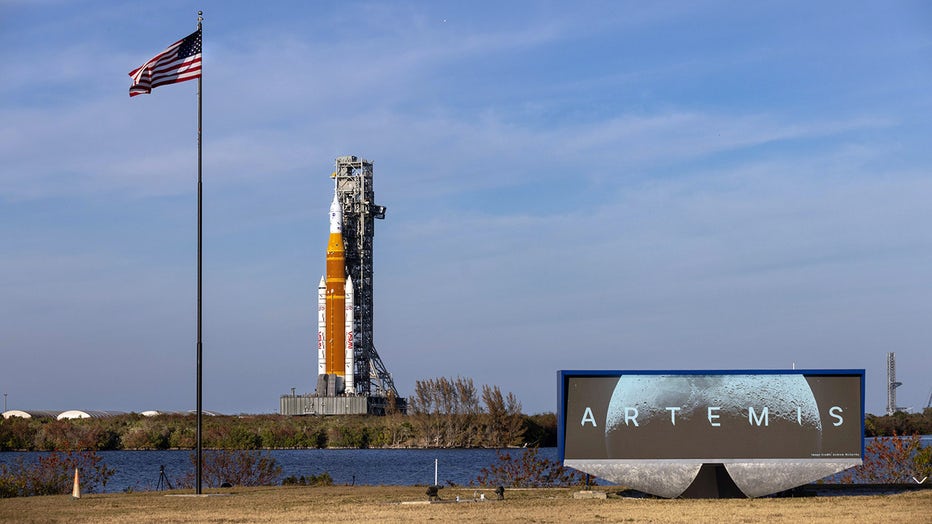
File: NASA’s Artemis II SLS rocket with the Orion spacecraft is seen Feb. 25, 2026. (NASA/Cory Huston)
The Space Launch System (SLS) is the successor to NASA’s space shuttle program, designed to send astronauts to the moon. Congress ordered that SLS use "heritage hardware" from the shuttle, and at a glance, the similarities between the two are obvious.
While the reusable winged orbiter has been replaced by a small Orion capsule, the SLS rocket’s main feature is still a giant orange fuel tank, and there are still two pencil-shaped solid rockets boosting the entire stack off the ground.
But it’s the business end of the rocket where the shuttle legacy is the most evident.
Artemis II SLS rocket engines
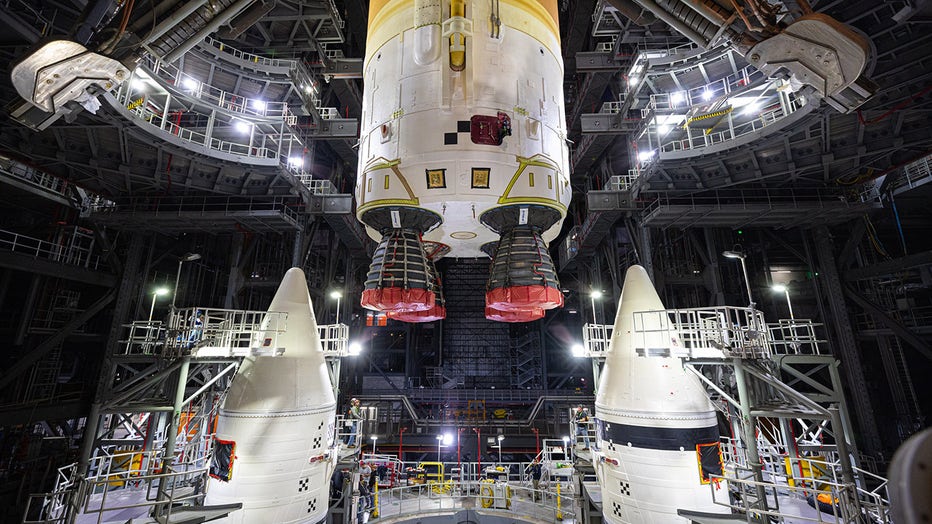
File: Teams integrate the SLS moon rocket with its solid rocket boosters inside High Bay 3 of the Vehicle Assembly Building at NASA’s Kennedy Space Center on Sunday, March 23, 2025. (NASA/Frank Michaux)
By the numbers:
The SLS rocket has four RS-25 engines – one more than the shuttle orbiter. Three of Artemis II’s four engines were flown on shuttles, where they were known as Space Shuttle Main Engines (SSMEs).
- Engine 2047: Debuted on a 1998 Discovery flight to the Mir space station and flew on a total of 15 flights, including STS-109 in 2002 – Columbia’s last successful flight. It was one of three engines aboard STS-135 Atlantis, the final shuttle mission.
- Engine 2059: Debuted on STS-117 in 2007, an Atlantis flight to the space station. Flew four more times, including Endeavour’s final flight in 2011.
- Engine 2061: Debuted aboard Endeavour on STS-130 in 2010 and then also flew aboard Endeavour’s final mission alongside Engine 2059.
- Engine 2062: This SLS rocket’s only unflown engine, built from what NASA calls "heritage flight spares."
Unlike the space shuttle, the SLS rocket is not designed to be reused. So this flight will be the last time these engines light up the sky.
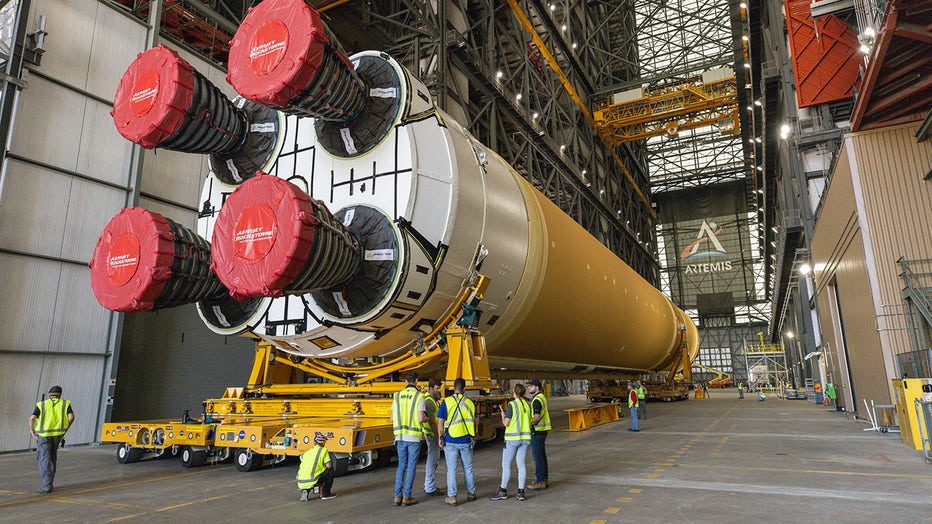
File: NASA teams transport the agency’s powerful SLS core stage into the transfer aisle inside Kennedy Space Center’s Vehicle Assembly Building on July 24, 2024. (NASA/Isaac Watson)
Dig deeper:
Even the Orion capsule includes a key piece of the shuttle. Its main engine actually flew six times as one of Atlantis’ orbital maneuvering engines – the ones sticking out of the pods on the back of the orbiter – as far back as 2000.
Artemis booster rocket history
The space shuttle’s solid rocket boosters burned for two minutes, then parachuted into the ocean to be refurbished and reused. While the SLS boosters won’t be reused, they do include segments dating back almost to the beginning of the shuttle program.
The oldest segment, near the top of the right booster, debuted on STS-5 in 1982. That was Columbia’s fifth flight and the first official "operational" shuttle mission.
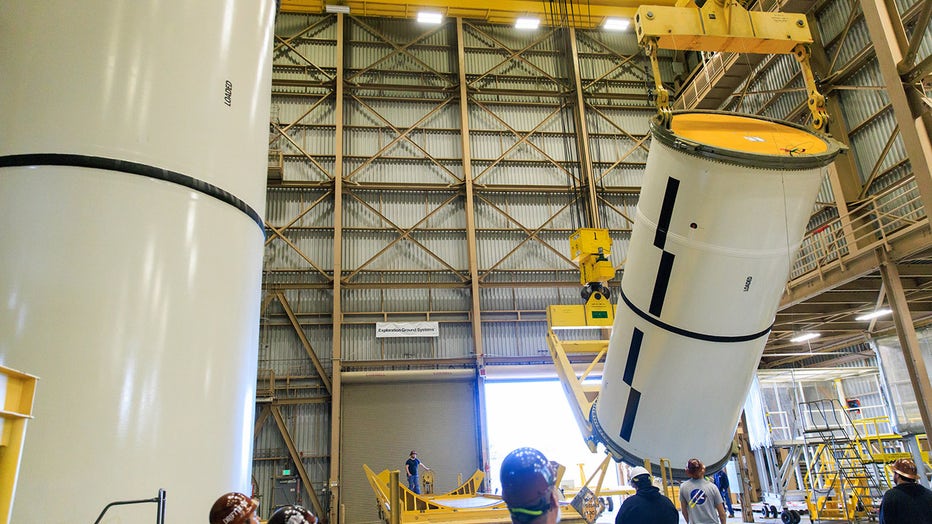
File: Crews rotate and lift reused SRB segments from horizontal into a vertical position in preparation for stacking on Dec. 21, 2023. (NASA/Frank Michaux)
Other notable heritage segments:
- Both boosters have segments from STS-8, a Challenger mission in 1983 that featured the program’s first night launch and landing.
- Each booster has multiple pieces that flew on STS-26, the post-Challenger return-to-flight mission in 1988.
- The right booster includes a nosecone and skirt that carried Columbia on its fateful final mission, STS-107.
In all, the left booster has elements that flew on 47 shuttle missions, and the right booster represents 64.
Following in footsteps
Other obvious space shuttle – and even Apollo – connections are there too. The rocket is still assembled in the now-iconic Vehicle Assembly Building, constructed in the 1960s to assemble the Saturn V moon rockets. And the mission will blast off from Pad 39B, site of 58 space shuttle and Apollo launches.
RELATED: What are all those black and white dots on NASA's Artemis I SLS rocket?
Artemis II mission
Big picture view:
Artemis II will carry four astronauts – including the first woman and first Black person – on a lunar flyby. They’ll be the first humans to leave Earth’s orbit since the last Apollo moon landing in 1972.
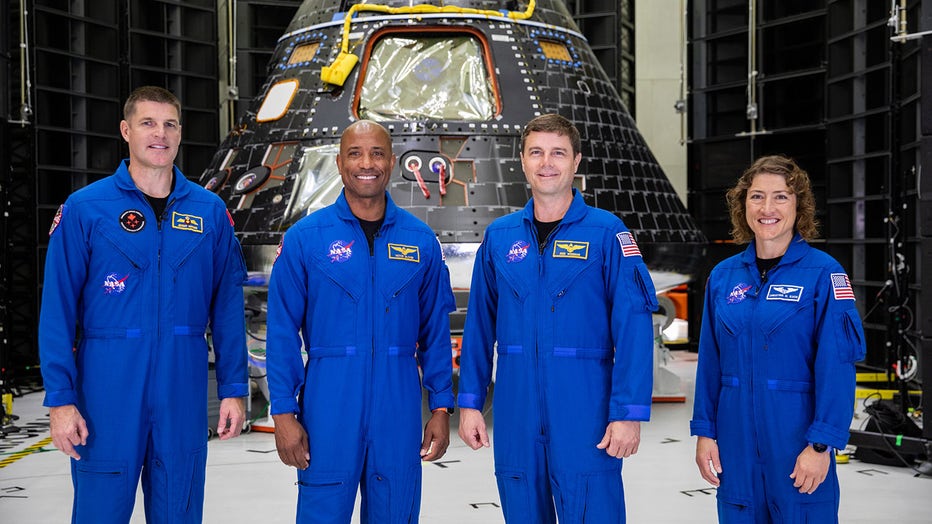
File: Artemis II crew members stand in front of their Orion crew module on Aug. 8, 2023. From left are: Jeremy Hansen, mission specialist; Victor Glover, pilot; Reid Wiseman, commander; and Christina Koch, mission specialist. (NASA/Kim Shiflett)
Artemis I successfully flew an uncrewed mission around the moon back in 2022. The 10-day Artemis II mission is meant to prove that the Orion capsule is capable of ferrying astronauts to lunar space and then safely back to Earth.
What's next:
NASA hopes the flight will set the stage for Artemis III, a test in Earth orbit of the lunar landers being developed by SpaceX and Blue Origin. If that goes well, Artemis IV could see astronauts landing on the moon as soon as 2028.
The Source: Information in this story came from NASA, the agency's SLS reference guide, the European Space Agency, and previous FOX Local coverage of Artemis I mission and the space program.